
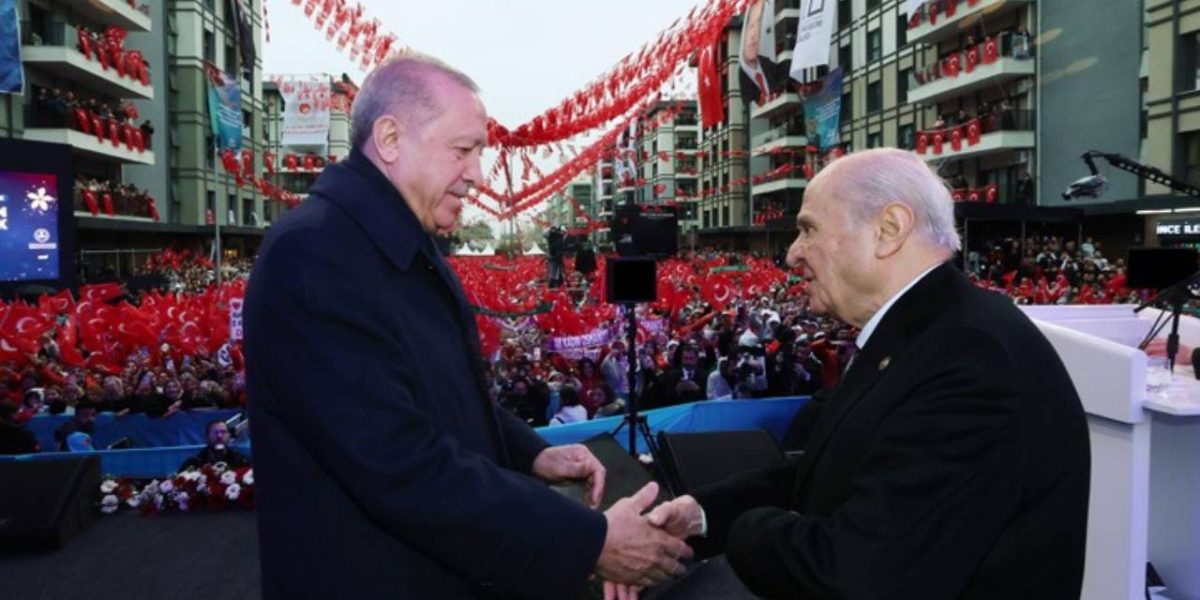
The CHP has been calling for an early election for nearly a year. The government appears to be turning a deaf ear to this call for now. We say ‘for now’ because in order for Erdoğan to stand for election once more, Parliament must inevitably pass a resolution for an early election. MHP leader Bahçeli, whilst closing the door on the opposition’s demands for early elections during his group meeting in Parliament yesterday, implied that the key to the matter lay with him, stating: “It is clear when the ballot box will speak. Its verdict will be revealed when the time comes.”
Bahçeli has, on several critical occasions, shifted the course of politics by simply saying “elections”. The November 2002 election that brought the AKP to power and the 16 April 2017 referendum that paved the way for Erdoğan’s presidency are two such instances. But this time the situation is different. Bahçeli appears to have handed over almost all initiative to Erdoğan, or been forced to do so. It is very difficult to speak of a distinct MHP will on important issues. Secondly, even if he were to make a move on the election, the parliamentary arithmetic limits Bahçeli’s room for manoeuvre. Bahçeli can only take the lead on the election date if he acts in cooperation with the opposition.
Therefore, reading Bahçeli’s statement merely as support for the regime may be an oversimplification. Viewed from another angle, it could also be interpreted as the MHP playing its final card against the regime. Moreover, in a process that began with İzzet Ulvi Yönter, continued with the removal of provincial and district organisations, and is said to be moving towards the judicial and bureaucratic branches, evaluating Bahçeli’s statement on the election from a single perspective would be insufficient. It is now common knowledge that what is happening within the MHP is not merely a matter for the MHP alone.
Erdoğan’s candidacy in the presidential election held on 14 May 2023 had conflicted with the constitutional principle that a president may be elected only twice. In a sense, he stood as a candidate and was elected despite the constitutional provision. It is now anticipated that he will stand as a candidate once again in violation of the constitution. There is a single condition for the path to be taken by circumventing the constitution: that is, the Parliament must pass a resolution for early elections with the votes of 360 MPs.
The AKP has 275 MPs, whilst the MHP has 46. In other words, the People’s Alliance has a total of 321 MPs. When parties such as Yeniden Refah and HÜDA PAR, with whom they stood in the election, are included, the figure rises to 330. That leaves a shortfall of 30 MPs. Support from the İYİ Party or the DEM Party is required; or a joint decision involving the CHP.
In short, the People’s Alliance needs external support to make Erdoğan a candidate once again. So, why would the opposition support Erdoğan to stand as a candidate once again?
The first and most straightforward answer is that support for an early election could also lead to continued power-sharing. In other words, the alliance would expand.
Secondly, a protocol could be signed regarding the steps to be taken after the election. This alone would mean diluting the regime’s power with a new partner.
Thirdly, the parties could reach an agreement on the date of the early election. However, judging by statements from the parties, this would actually require the election to be brought forward. The likelihood of the November 2027 date being accepted as an ‘early election’ is extremely low.
HOW WILL THE ELECTION TAKE PLACE?
Erbakan, the General Chairman of the Refah Party, which supported the People’s Alliance in the last election, described the process leading up to the ballot box in an interview with journalist Şirin Payzın, and subsequently made the much-debated statement: “They want to hold a controlled election.” In other words, an election where everything—from the rival candidate to the election conditions and date—is determined by the regime.
Erbakan’s assessment of the regime’s intentions has been described for months by various sections of the social opposition as the “symbolic nature of the election and the ballot box”. The fact that this statement was made by the leader of a party that supported the regime in the previous election is the only significance of the matter.
Yes, the intention is clear. A controlled election is being designed, the outcome of which they already know. But how can any control be established when there are still question marks over whether Erdoğan will even stand as a candidate? What game will they play when the candidate isn’t even certain?
Events over the past few months show that, far from organising a controlled election, there is a regime that has completely lost control of the country’s governance. Every operation carried out against the opposition inevitably touches upon one of the power centres within the regime. It is no coincidence that the process of shedding light on the Gülistan Doku case extends all the way to the power struggles within the regime and the AKP-MHP rivalry.
Although the opposition is subjected to attempts to crush, fragment and subdue it on a daily basis, the regime’s predicaments are far greater. The ‘post-leader regime struggle’ present in both parties has already begun. The regime struggle has progressed to the point of interfering in the internal affairs of the alliance partner. The economic crisis, political weariness and the leaders’ exhaustion have heightened the tension along the fault lines of the People’s Alliance.
Under these conditions, it is virtually impossible for Erdoğan to stand as a candidate once again. The future of the AKP-MHP bloc now hinges on support from the opposition. Let us ask the question on everyone’s mind: will the opposition make the move that could once again serve as a lifeline for the People’s Alliance?
Note: This article is translated from the original article titled Bahçeli’nin seçim saati çok tuhaf çalışır: Erdoğan’ın adaylığı gerçekten ‘cepte’ mi?, published in BirGün newspaper on April 21, 2026.

Bir yanıt yazın